
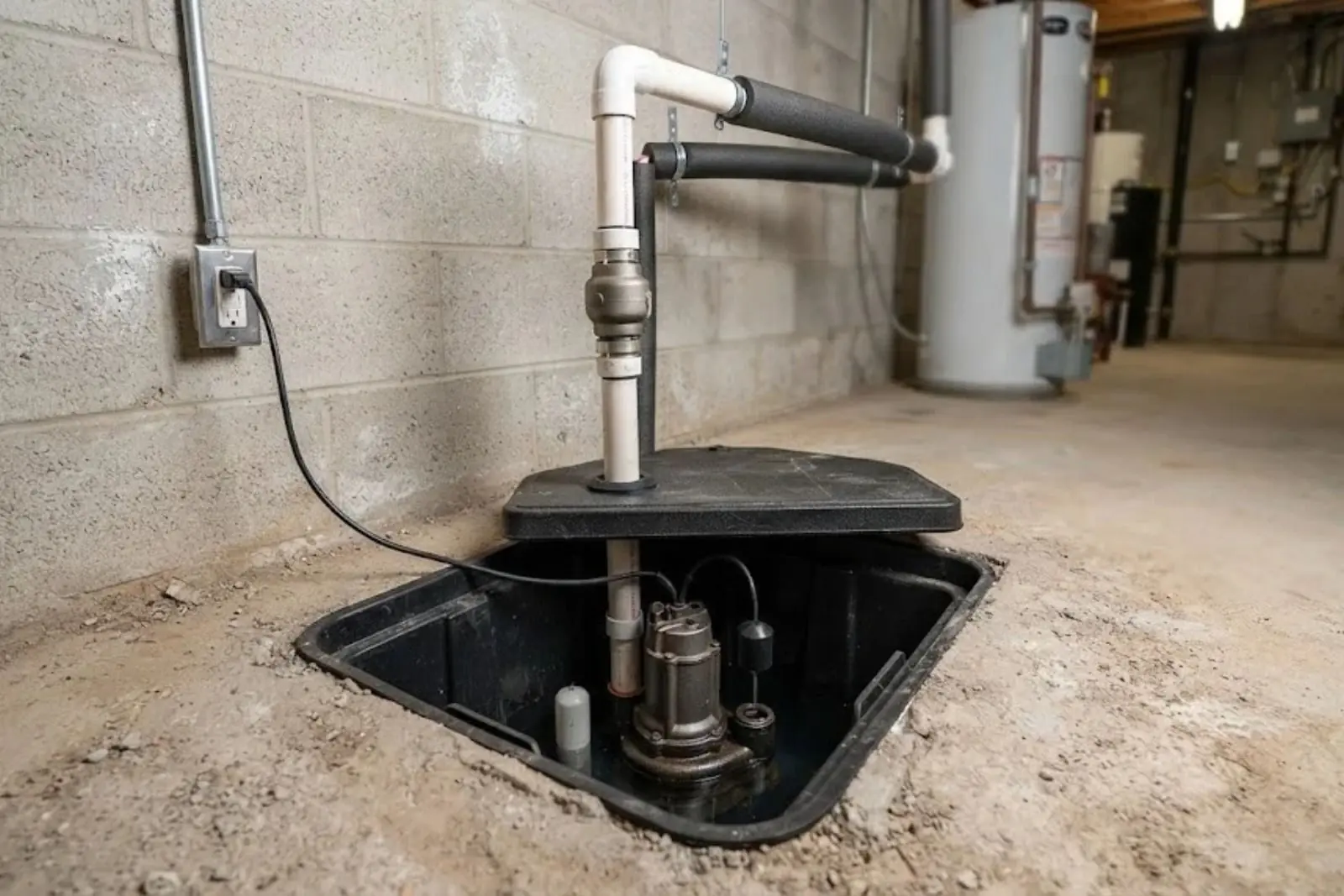
When the pump fails during a storm
A sump pit that fills with no pump running means water will rise to the floor. Check whether the pump has power, then check the float, which may be stuck against the wall of the pit. If you can safely free it, the pump may start. If not, call (973) 488-5410.
Do not stand in water around electrical equipment. Keep belongings off the floor and, if the water reaches outlets, stay out of the basement until power is shut off.
Why sump pumps fail
Many pumps are simply old. A pump that has run for a decade is on borrowed time.
| Cause | What you notice | What we do |
|---|---|---|
| Power loss | Pump does not run in a storm | Add a battery backup |
| Stuck float | Pump does not turn on or will not stop | Reset or replace the float |
| Worn motor | Loud, running constantly or tripping the breaker | Replace the pump |
| Clogged or frozen discharge | Pump runs but water does not leave | Clear or reroute the line |
| Failed check valve | Pump cycles often | Replace the valve |
Montclair, storms and basements
In early September 2021 the remnants of Hurricane Ida flooded basements and streets across northern New Jersey, and Montclair homeowners were among those affected. Storms like that test every sump pump in the area. A pump that has not been tested recently may fail when it is needed.
The practical lesson is to test the pump before the storm and to have a backup if the power goes out. A battery backup keeps the pit pumping when the grid fails, which is exactly when the water is highest.
Where the water goes
Local sewer rules generally keep stormwater out of the sanitary sewer. That means a sump discharge should go to the yard or a storm connection where allowed, not into the house drain. We ask where yours goes before we recommend changes, and we move it if it ties into the wrong place.
Discharge lines can freeze in winter, and a frozen line stops the pump from working. We route and slope lines to reduce that risk.
What affects the price of sump pump work
A repair and a new installation are different jobs.
- Repair or replacement of the pump.
- Pump size and type, and whether a battery backup is added.
- Pit condition and discharge routing.
- Electrical outlet and circuit.
- After hours dispatch during a storm.
Standard homeowners policies often exclude flooding and may not cover sump pump overflow unless you carry a rider. Ask your carrier before storm season. Call (973) 488-5410 for a price on your pump.
Installing a new sump system
A new system can be planned alongside basement waterproofing when water enters in several places.
- Assess the basement. We check where water enters and where the pit should sit.
- Set the pit. We cut the floor, set the basin and pump and connect the discharge.
- Add a check valve and backup. A check valve keeps water from flowing back, and a battery backup protects against power failure.
- Test. We run water into the pit to confirm that the pump starts and discharges.
Codes and standards behind the work
Pump outlets should be on a GFCI protected circuit under the National Electrical Code (NFPA 70).
Sump pump service across Montclair and nearby towns
We serve Montclair, Glen Ridge, Verona, Cedar Grove and Bloomfield. For sewer backups that happen in storms, see sewer line repair.
Sump Pump questions from Montclair homeowners
Yes. Dispatch at (973) 488-5410 answers during storms, overnight and on holidays. Tell us how deep the water is and whether the pump has power.
Test it a few times a year and before storm season by pouring water into the pit to see that the pump starts and the water leaves.
If your basement floods when the power goes out in storms, a backup is worth having. We help you size it.
Many last around a decade, depending on use. A pump that runs often wears faster.
Local rules generally keep stormwater out of the sanitary sewer. We check where your pump should discharge.
A stuck float, a failed check valve or high groundwater can cause constant running. We diagnose the cause.
Yes. Call (973) 488-5410 to discuss a new pit and pump.