
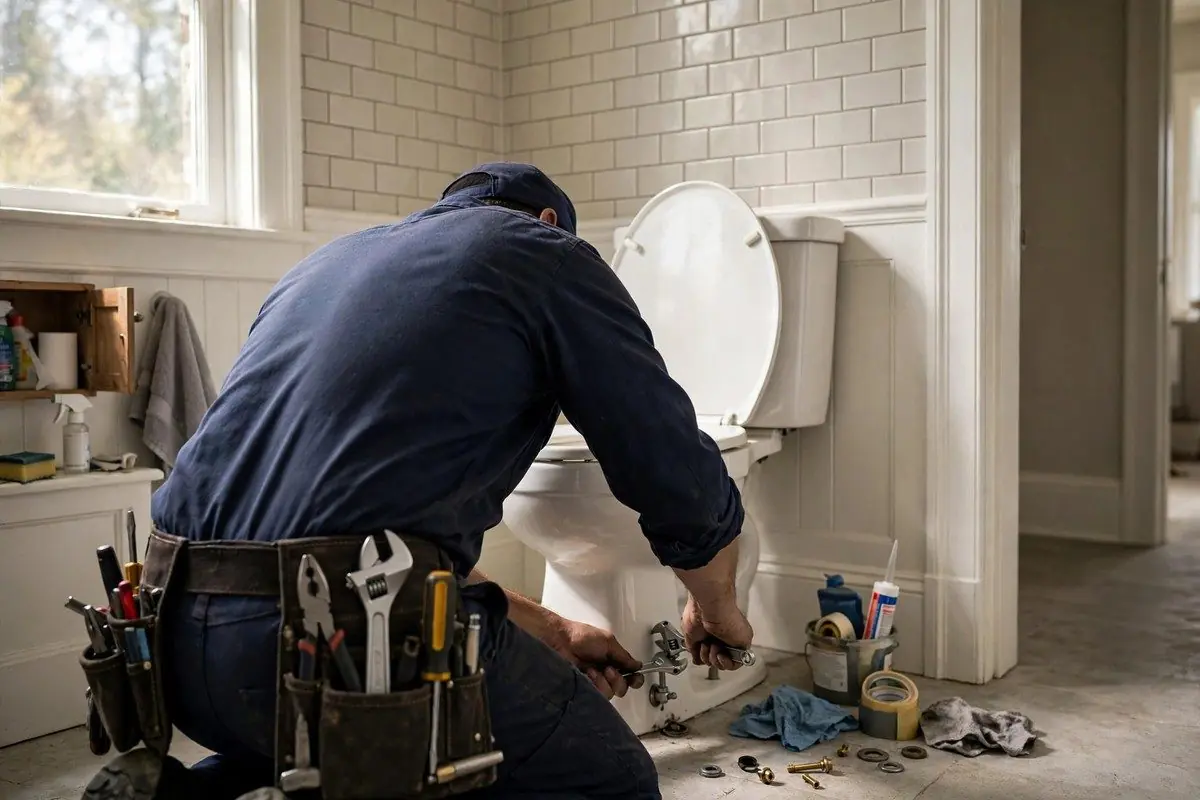
The float valve, now usually called a fill valve, controls how much water enters the toilet tank after a flush. When it wears out, the toilet keeps running, hisses, fills slowly or never shuts off. Replacing it is one of the more approachable plumbing repairs and takes about thirty minutes.
This guide shows the steps and the mistakes to avoid. If the shutoff valve will not turn or something else looks wrong, call (973) 488-5410.
Is it the fill valve or the flapper?
A running toilet has two main suspects. The flapper is the rubber seal at the bottom of the tank, and the fill valve is the tall assembly that refills it. Telling them apart saves you from buying the wrong part.
| Symptom | Likely part | Quick test |
|---|---|---|
| Water trickles into the bowl all the time | Flapper | Add food coloring to the tank and see if it reaches the bowl |
| Hissing and the tank never stops filling | Fill valve | Check whether water runs into the overflow tube |
| Slow refill | Fill valve or clogged supply | Open the supply valve fully |
| Tank overflows | Fill valve set too high | Lower the float |
Replacing the fill valve
- Shut off and drain. Close the supply valve behind the toilet and flush to empty the tank.
- Disconnect the supply line. Unscrew it from the bottom of the valve, using a towel for drips.
- Remove the old valve. Loosen the locknut under the tank and lift the valve out.
- Install the new valve. Set it in the tank hole, tighten the locknut by hand and set the height as instructed.
- Reconnect and test. Reattach the supply line, open the valve slowly and check for leaks.
- Adjust the water level. Set the float so the water stops about an inch below the top of the overflow tube.
Common mistakes
- Overtightening the locknut and cracking the tank.
- Setting the water level above the overflow tube.
- Skipping the supply line check and leaving a slow leak.
- Buying a valve that does not match the tank height.
Old shutoff valves in Montclair houses
Many Montclair houses have shutoff valves behind the toilet that are decades old. Some will not turn, and some leak when turned. Mineral scale in the water, which you can look up in the township water quality report, can also clog a new valve. If the shutoff will not close, stop and call, because forcing it can break the pipe.
When to call a plumber
Call if the shutoff leaks, if the tank cracks or if the toilet keeps running after a new valve and flapper. See toilet repair for what we do, and drain cleaning if the bowl also drains slowly.
Types of fill valves
Fill valves come in a few styles. The older ballcock has a metal arm and a float ball, and it is still found in many older toilets. Modern fill valves use a cup float that slides up the valve body and are quieter and easier to adjust.
Most replacement valves are universal and fit many tank heights. Check the package for the height range before you buy, and take the old valve with you if you are unsure.
Setting the water level
The water level matters. If it is too high, water runs into the overflow tube and the toilet runs constantly. If it is too low, the flush is weak. Most tanks have a fill line marked inside, and the level should stop about an inch below the top of the overflow tube.
After you adjust it, flush a few times and watch. A hiss that does not stop means the valve is not closing, and a water level that creeps up means the flapper is leaking and refilling the tank.
Step by step: swapping the fill valve
Close the supply valve, flush to empty the tank and sponge out the last water. Disconnect the supply line at the bottom of the tank and loosen the nut under the old valve. Lift it out, drop the new valve in and tighten its nut by hand, then a quarter turn with pliers.
Reconnect the supply line, clip the refill tube to the overflow pipe and turn the water on slowly. Adjust the float until the water stops at the fill line.
Signs it is time for a new valve
A toilet that fills slowly, runs on after a flush or makes a whine as it fills often has a worn fill valve. Replacing it costs little and saves water on every flush. If the problem comes back, check the flapper and the tank seals as well.
Codes and standards behind the work
Fill valves are made to ASSE 1002, the anti siphon standard for toilet tanks, which keeps tank water from being drawn back into the supply.
Where to call
We repair toilets across Montclair and in Glen Ridge. The service area page lists the towns we cover.
Float valve questions
Many last several years, but mineral scale and wear shorten their life.
Most are universal, but check the height range against your tank.
A leaking flapper lets water slip into the bowl and triggers a refill.
Minerals can wear parts. The annual water quality report lists hardness.
Only if the toilet shutoff does not work. Then call a plumber.