
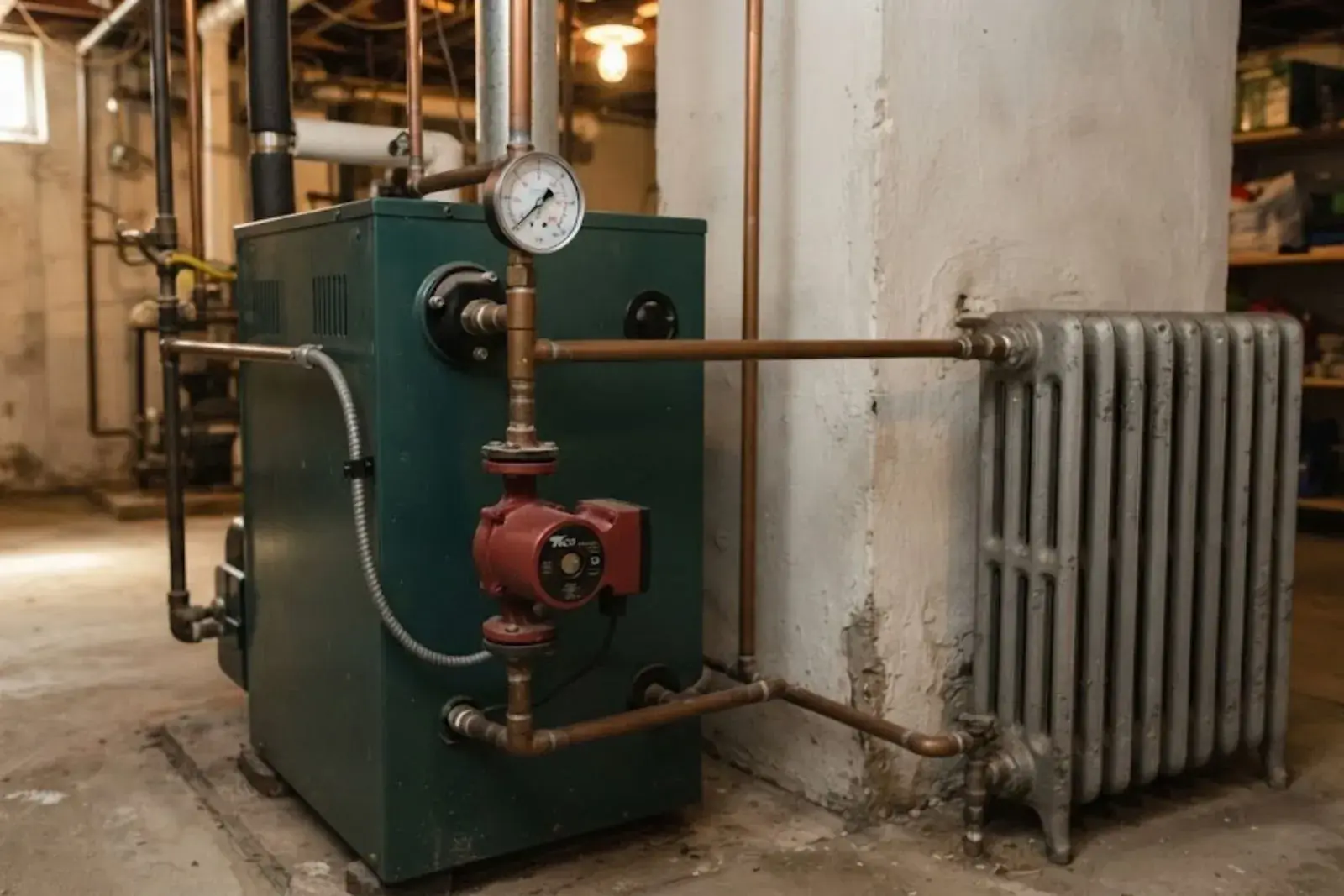
Why a boiler stops heating
Boilers rely on water, fuel, a spark or pilot and a circulating pump. A fault in any of them stops the heat. The most common causes are low water pressure, a failed circulator pump, a faulty thermostat or an igniter that no longer lights.
Check the pressure gauge before you call. If it reads near zero, the system has lost water, which suggests a leak. Do not add water without guidance because a hot boiler can be damaged by cold water.
Common boiler problems
Boilers are serviceable for many years, and good maintenance extends that. Age matters, and we are honest when replacement is wiser than repair.
| Symptom | Likely cause | Typical repair |
|---|---|---|
| No heat | Pump, thermostat or ignition fault | Test and replace the failed part |
| Banging or kettling | Sediment or low water flow | Flush and check the pump |
| Pressure too low | Leak or a failed expansion tank | Find the leak, adjust the tank |
| Pressure too high | Failed expansion tank or relief valve | Replace the failed part |
| Cold radiators | Trapped air or poor circulation | Bleed radiators and check the pump |
Boilers in older Montclair homes
Many Montclair houses built before the middle of the last century were designed around a boiler and radiators. The boiler may have been replaced, though the piping and radiators can be original. Older systems have longer pipe runs and more places where air or sediment can collect.
This is why diagnosis matters. A radiator that stays cold may have air in it, or the system may have a balance problem. We check the whole loop before replacing parts.
Regular maintenance
An annual service finds worn parts before a cold night does. Combustion checks, pressure checks and a look at the venting protect you from carbon monoxide and from emergency calls.
- Check pressure and the relief valve.
- Inspect the circulator pump and expansion tank.
- Clean and test ignition and burner.
- Check venting and combustion air.
- Bleed radiators and look for leaks.
What affects the price of boiler repair
Boiler repairs range from simple adjustments to major parts.
- The failed part and its availability.
- Age and model of the boiler.
- Fuel type and venting.
- Access in the basement.
- Time of day, especially in cold weather.
Insurance seldom covers boiler failure from age or wear, while sudden damage from a burst pipe may be treated differently. Call (973) 488-5410 and we will give you a price after we see the system.
Safety and carbon monoxide
Fuel burning appliances can produce carbon monoxide when they are not venting or burning properly. Working detectors on every floor are essential, and a boiler with soot, a yellow flame or a smell of gas needs a technician right away. If a detector sounds, leave the house and call 911.
We check combustion and venting as part of a boiler repair, and we tell you what we find, even when it is not what you called about.
Codes and standards behind the work
Gas fired boilers fall under the National Fuel Gas Code (NFPA 54), which covers piping, venting and combustion air, and permit rules in New Jersey are set by the local construction office.
Boiler repair across Montclair and nearby towns
We serve Montclair, Glen Ridge, Verona, Cedar Grove and Bloomfield. If a leak is part of the picture, see leak detection.
Boiler Repair questions from Montclair homeowners
A leak somewhere in the system or a failed expansion tank is the usual cause. We find the source before adding water.
Trapped air. Bleeding the radiator often fixes it, and persistent problems point to the pump or balance.
Annually, before the heating season, is the common recommendation.
It may indicate sediment or poor flow. It deserves a look before it damages the heat exchanger.
Our focus is hot water systems. Call (973) 488-5410 to describe your system and we will tell you whether we can help.
We can discuss replacement when repair is not sensible. Call to arrange an assessment.